Layout and utility locate
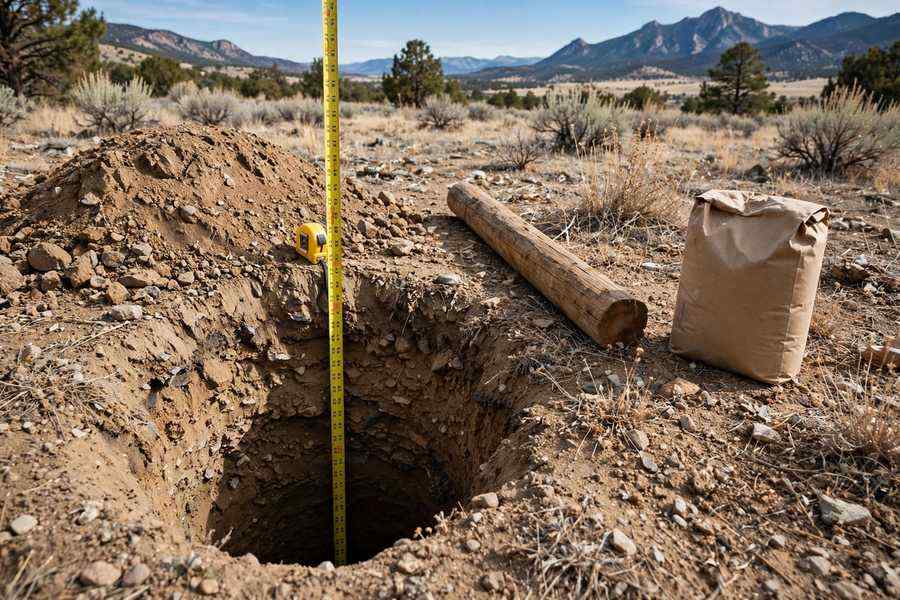
We mark the fence line with stakes and a string line, confirm property boundaries, and contact Colorado 811 for utility locates before any digging starts. A split rail run is usually long, so the layout has to be right.
Every split rail fence we build comes with the same core scope: layout, post setting, rails, gates, and cleanup. Here is what is covered, and what we will flag before we start if your lot needs something different.
We mark the fence line with stakes and a string line, confirm property boundaries, and contact Colorado 811 for utility locates before any digging starts. A split rail run is usually long, so the layout has to be right.
Split rail posts go deep in concrete — frost depth in the Denver metro is commonly cited at about 36 inches — because a rail fence is only as straight as its posts, and a heaved post shows across a long open run.
Rails are split cedar, set into mortised posts in the traditional two- or three-rail pattern. We talk through two-rail against three-rail before ordering: three-rail reads more finished and keeps a small animal in better.
A split rail gate gets a braced frame and heavy hinges. We hang it, test the swing, and adjust the latch before we leave. A rail gate is light, but a shallow post still leans under it.
We check the Denver rules for your address — 4 feet in front of the primary facade, 6 feet behind it, zoning permit over 4 feet — and help with HOA submittals. Some HOAs restrict split rail to rear lots or ban it outright, so we check before you commit.
Old split-rail fence, concrete footings, and scrap all go in the trailer. We rake the work area, sweep the driveway, and walk the line with you before we leave.
Split rail fence installation Denver CO is the process of setting mortised posts in concrete and fitting split cedar rails into them in a two- or three-rail pattern. There is no fabric, no pickets, and no privacy — the fence is a boundary marker, and the gaps between the rails are the point. The work is in the layout: a long open run has to be straight, the posts have to be evenly spaced, and the rails have to sit level in their mortises.
Most Denver homeowners choose split rail for a larger lot, an open edge, or a property where the fence is a marker rather than a screen. The research skews this fence to acreage, the east side of I-25, and the foothills — not to the tight grid lots of central Denver, where a split rail fence would look out of place and do nothing a boundary needs to do. On a big lot, it is the cheapest honest fence in the market guides.
Every job follows the same four steps, whether it is a 100-foot run on a large lot or a 400-foot perimeter on open ground. You will know what happens each day.
Call
Call (720) 697-2456, Monday through Sunday, 7:00 AM to 8:00 PM. We talk through the split-rail fence, the yard, and the lot, and set a time to measure.
Measure & plan
We measure the line to the rail length, check the ground and the slope, note trees and roots, and confirm the height, permit, and HOA rules for your address — including whether split rail is allowed where you live.
Build
Posts go in concrete and cure, rails are fitted into the mortises level and straight, and gates are hung and tested. We keep the site tidy as we go.
Walk-through
We walk the finished split-rail fence with you, check every gate and latch, and clear the site before we leave.
Post hole digger and auger
Used to bore clean holes deep enough to clear the frost line. A long open run shows a heaved post from a long way off.
String line and level
The string line keeps the fence straight over hundreds of feet, and the level keeps every post plumb and every rail level. A split rail fence is all line — a crooked run shows.
Mortise chisel and mallet
Posts are mortised to take the rails, and the rails are trimmed to sit tight in the mortise. A loose rail rattles in the wind and works its way out.
Circular saw
The circular saw cuts rails to length where a run ends at a gate or a corner. A rough cut shows on a split rail fence, so the cut is kept clean.
Tamper and wheelbarrow
The tamper packs soil around each footing so the split-rail fence post does not shift, and the wheelbarrow moves concrete mix to the hole.
Level and square for gates
The rail gate is built square and hung on a braced post. We check the diagonal before the gate goes on the hinges, not after.
Posts set below Denver frost depth
Frost depth in the Denver metro is commonly cited at about 36 inches, and the exact code figure for fence posts is not settled in the sources we reviewed — so we treat 36 inches as the floor, never the target, and set split-rail fence posts in concrete.
Rails seated tight in the mortise
Each rail is trimmed to sit tight in its mortise, so it does not rattle in chinook wind or work loose in freeze-thaw ground.
Two-rail or three-rail, chosen for the lot
Two-rail is the lighter, more open look; three-rail reads more finished and keeps a small animal in better. We talk through which suits the lot before ordering.
Wire mesh where containment matters
A split rail fence will not keep a dog in on its own. Where a dog or a small animal has to stay in, welded wire mesh can be fixed to the rails — we talk through that before the build, not after.
01
What we do:We measure the line, talk through two- or three-rail cedar, check the permit and HOA rules for the address, and build it. The fence marks the lot without closing off the open ground.
→ A boundary that suits the lot's scale and leaves the view alone.
02
What we do:We measure the edge, talk through a low split rail run that marks the lot line without blocking the trail or the view, and build it. A split rail fence is the right marker where a solid fence would be a wall.
→ A lot line that is marked, not walled off.
03
What we do:We measure the paddock, talk through three-rail cedar with wire mesh where containment matters, and build it. Split rail is the traditional paddock fence, and it reads right on a rural lot.
→ A paddock fence that suits the property and keeps the animals where they belong.
04
What we do:We measure the front run, talk through a low split rail edge at or under the 4-foot front limit, and build it. The fence frames the lot without hiding the house or the ground.
→ A front boundary that suits a large lot and stays within the front-yard rules.
Split rail is the fence that belongs on Denver's edges, not its center. The research skews it to acreage, the east side of I-25, and the foothills — larger lots, open ground, and properties where the fence is a marker rather than a screen. On a tight central-Denver lot it is the wrong fence: it gives no privacy, it will not keep a dog in, and it looks out of place on a 25-foot lot. On a big lot, it is the cheapest honest fence in the market guides, and it suits the ground.
Brick ranches from the 1950s to early 1970s on generous lots, with the High Line Canal running through the middle. Large corner lots are common, and I-25 bounds the east edge. On these streets, a split-rail fence is the usual call.
About 4,000 homes built between 1954 and 1957, including 130 to 170 Cliff May prefab ranches — the largest Cliff May tract outside California. Flat, wide lots with detached garages and private courtyards. A split-rail fence is the usual call on these streets.
Modest 1950s brick ranches subdivided in the early 1950s. Several homes back directly onto Ash Grove Park or Cook Park with private gates — a park-gate fence is a documented feature here. These streets usually call for a split-rail fence.
Master-planned community on the former Stapleton airport, built mostly 2002 to 2019. The Master Community Association and sub-associations review fence designs before the city permit — two approvals, in that order. On these streets, a split-rail fence is the usual call.
A former smelter company town of small worker cottages, cut by I-25 and I-70. Many homes back onto freeway embankments or industry, and the western edge sits in South Platte River floodplain — verify per lot. A split-rail fence is the usual call on these streets.
Freeze-thaw cycles that heave shallow posts
Denver's freeze-thaw ground lifts shallow posts within a winter or two. Frost depth is commonly cited at about 36 inches in the metro, and posts set shallower than that are the usual cause of a leaning fence. For a split-rail fence, that means posts set deep in concrete — shallow footings are the first thing we check.
Chinook wind that loads solid fences
Chinook gusts on the Front Range can top 80 mph on the I-25 corridor. A solid 6-foot privacy run catches the full wind load, which is why posts, footings, and rail fastening matter more than the pickets. On a split-rail fence job, Chinook gusts are part of the footing plan, not an afterthought.
Sloped and stepped lots
Most central Denver lots are flat, but hillside and split-level lots need stepped or racked panels and deeper footings on the grade change. A split-rail fence on a sloped lot needs stepped or racked panels and deeper footings where the grade changes.
Denver permit and sight-triangle rules
Denver caps fences at 4 feet in front of the primary street-facing facade and 6 feet behind it, and any fence over 4 feet needs a zoning permit. Corner lots have sight-triangle limits near intersections, and fences sit at least 6 inches back from the public sidewalk. For a split-rail fence, we check the height and the sight triangle for your address before we quote.
Most split rail calls start with a problem, not a wish list. Here are the four we hear most often, and how we handle each one.
Problem
A rail that was trimmed loose rattles in chinook wind and works its way out of the mortise over a season or two.
Our Fix
We re-seat the loose rails and trim replacements to sit tight. A rail that fits its mortise does not rattle out.
Problem
A heaved post shows across a long open run — the rails go out of level and the whole line looks wavy.
Our Fix
We dig out the failed footing, reset the post deep in fresh concrete, and re-seat the rails. If the rail is undamaged, you keep it.
Problem
A rail gate on a shallow post leans, and the latch stops meeting the post. Keep forcing it and the hinges pull out.
Our Fix
We diagnose the cause first — post, hinges, or frame — reset the post if it has leaned, and rehang the gate with a braced frame, then test the swing.
Problem
A split rail fence will not keep a dog in on its own — the gaps between the rails are the point of the fence, and a dog walks through them.
Our Fix
We talk through the honest fix: welded wire mesh fixed to the rails, or a different fence for the dog's run. Our dog-fence page covers physical fences and dog runs in detail.
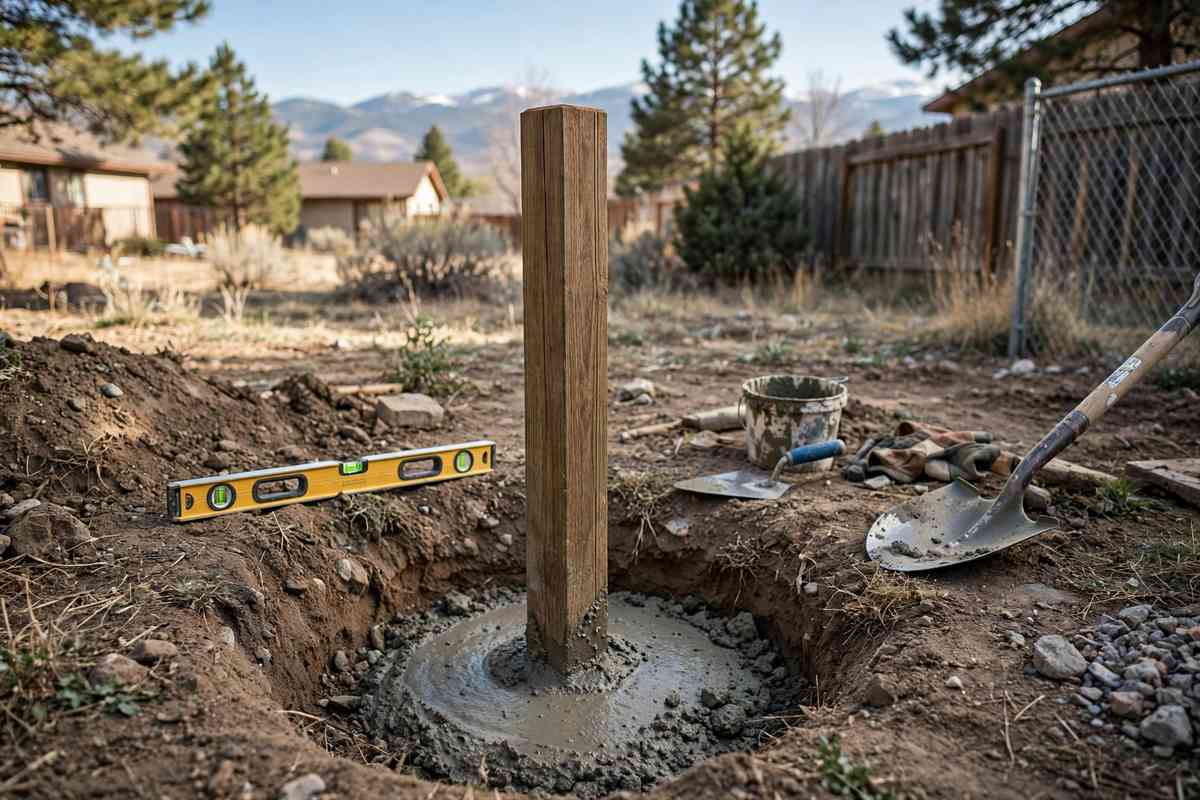
Split rail is the cheapest honest fence in the Denver market guides, and the right fence for the right lot. Here is what you actually get when we build yours.
Lowest cost for a long run
Split rail costs less per foot than any other permanent fence in the Denver market guides. For a long boundary on a large lot, the difference against wood or vinyl is large.
Marks the lot without closing it off
A split rail fence is a boundary, not a wall. It marks the lot line, frames the open ground, and leaves the view, the light, and the air alone.
Suits the rural edge
Split rail is the traditional ranch and paddock fence, and it reads right on larger lots, open edges, and properties toward the foothills. It does not belong on a tight urban lot — and we will say so.
What split rail fencing costs in the Denver market
Third-party market guides published in October and November 2026 put split-rail fencing at $9 to $13 per linear foot installed. Sources: NumeralQ, 26 Oct 2026. Those are market ranges, not Payless Fence Company prices. Call (720) 697-2456 with your fence length and material and we will talk through a quote for your yard.
Google ★★★★★4.9 out of 5
Rated 4.9 out of 5 from 27 Google reviews. Read the reviews on our Google Business Profile, or call (720) 697-2456 to talk about your fence.
Split rail in Denver is a layout job: long straight runs, deep concrete footings in bentonite clay, and rails seated tight in their mortises. We build it for larger lots and open edges — and we will tell you plainly when your lot is too tight for a split rail fence to make sense.
Payless Fence Company is rated 4.9 out of 5 from 27 Google reviews. We keep it to the aggregate here; individual review text is not reproduced on this page. Call (720) 697-2456 to talk about your split-rail fence.
★★★★★
4.9 out of 5
Based on 27 Google reviews for Payless Fence Company. We do not publish customer quotes on this page; read the reviews on Google, then call us to talk about your fence.
Call (720) 697-2456Real answers to the questions we hear most often about split-rail fence from local homeowners and property managers.
Cedar and pressure-treated pine fences built for Denver clay, frost, and hail. Pairs with a split-rail run on the same lot.
View Wood Fence InstallationPost, rail, picket, and gate repairs, including storm and freeze-thaw damage. Often built on the same lot as a split-rail fence.
View Fence RepairPhysical fences and dog runs that keep dogs in and the yard usable. A common companion to a split-rail fence.
View Dog Fence InstallationGalvanized and vinyl-coated chain link for yards, dog runs, and side lots. Pairs with a split-rail run on the same lot.
View Chain Link Fence InstallationFull-height 6-foot privacy runs for backyards, alleys, and patios. Often built on the same lot as a split-rail fence.
View Privacy Fence InstallationLow wood and vinyl picket fences for front yards and garden edges. A common companion to a split-rail fence.
View Picket Fence InstallationCall (720) 697-2456 to talk about a split rail fence. We answer Monday through Sunday, 7:00 AM to 8:00 PM. Have your approximate fence length, the lot size, and your neighborhood ready, and we can talk through the next steps on the call.
Phone
(720) 697-2456Address
Payless Fence Company LLC, Denver, CO 80201, US
Hours
Mon–Sun 7:00 AM–8:00 PM